Variable Rate Spreading
At a Glance
| Challenge | Knowing where, and how much fertiliser to spread in an orchard for optimum tree growth is a significant management challenge in commercial orchards. |
|---|---|
| Solution | Green Atlas Cartographer enables objective and repeatable tree assessment at scale (both fruit and tree vigour metrics), to create prescription fertiliser maps to apply to automated variable rate spreading equipment. |
| Result | Fertiliser is only applied exactly where needed, resulting in a more uniform and productive orchard, lower input costs, and reduced environmental impacts. |
| Applicable Crops / Stages | All crops and stages. |
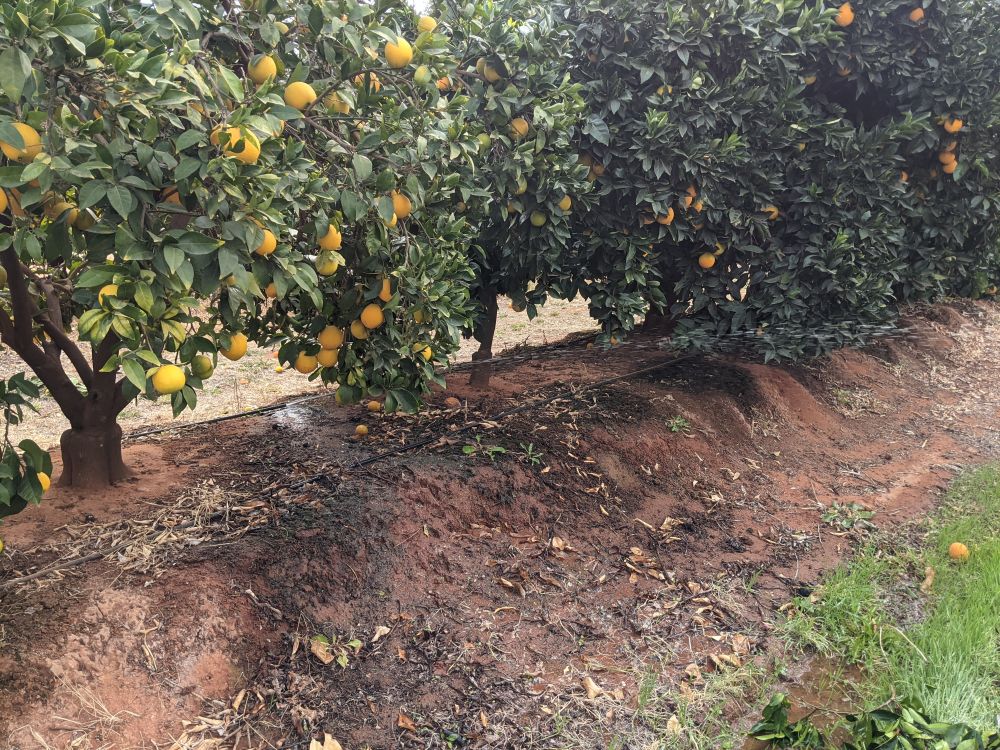
The Cost of Nutritional Imbalance
Nutritional needs are as unique as your trees.
Managing orchard nutrition is traditionally based on soil and leaf samples that represent only a fraction of the orchard. This leads to several inefficiencies:
- Uniform Application Trap: Applying a uniform rate across a block fails to address the different needs often present within a block. Trees with high nutrient demand may be under-applied, and vice-versa.
- Environmental and Financial Waste: Excess fertiliser can leach into groundwater or run-off, while also contributing to soil acidification. This represents both a lost financial investment and a potential environmental hazard.
- Aggravating Variability: Blanket spreading has the potential to increase orchard variability. Over-fertilising already vigorous trees is likely to make them more vegetative, while under-applying on high-crop-load trees can lead to nutrient exhaustion and poor fruit quality.
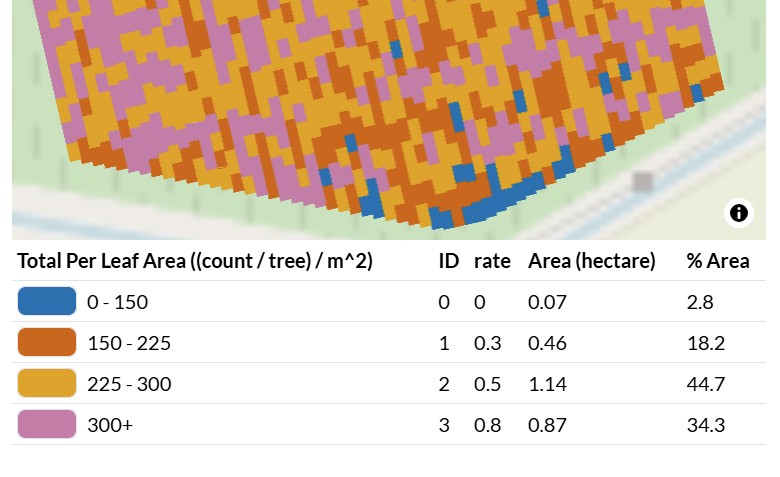
Multi-Layered Prescription Maps
Replace point sampling with a total orchard census.
Green Atlas Cartographer provides the objective ground-truth required to feed every tree according to its actual needs.
- Dual-Metric Assessment: The system simultaneously maps Fruit Count (nutrient export) and Canopy Volume/Density (vegetative vigour). This enables a replacement strategy; feeding the tree based on the crop it is carrying and its current health.
- Digital Prescription Maps: The raw data is processed into a Zone or Grid Map, making it easy for an agronomist to set spreading rates to address the variability within the block. This map is converted into a standard format (like a Shapefile or Geojson) that talks directly to the spreader’s rate controller.
- Repeatable Monitoring: Because the Cartographer scans are fast and cost-effective, growers can monitor the orchard's response to the fertiliser mid-season and adjust subsequent applications accordingly.
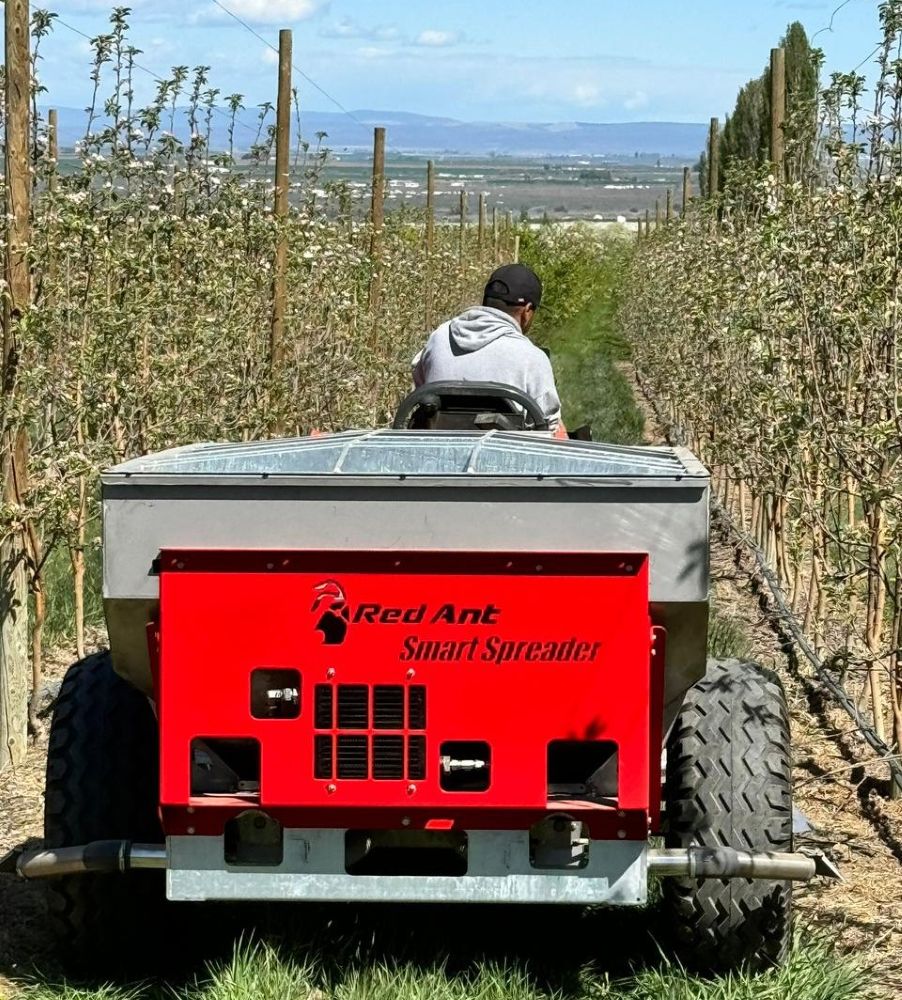
Nutritional Precision and Sustainability
Accurately match nutritional inputs to the demands of each tree
By matching input to demand at the individual tree or zone level, the orchard block becomes a more efficient production unit:
- Lower Input Costs: Growers are likely to see significant reductions in total fertiliser volume by simply not applying product to gaps, dead trees, or zones that have already reached their growth ceiling.
- Reduced Environmental Footprint: Minimizing over-application directly reduces the risk of chemical leaching and run-off, helping orchards meet increasingly strict environmental regulations and sustainability certifications.
- Enhanced Orchard Uniformity: By providing extra nutrients to struggling zones and tempering the inputs in over-vigorous zones, the block moves toward a more homogenous state.
- Improved Fruit Quality: Balanced nutrition leads to better fruit firmness, storage potential, and colour, as trees are neither starved nor pushed into excessive vegetative growth.
Variable Rate Spreading Examples
The two primary agronomic strategies
The ‘Vigour Correction’ Strategy (Canopy Focus)
Agronomic Insight: Large, overly-vigorous trees do not need more nitrogen.
Spreading Strategy: The spreader reduces or shuts off the rate for high-vigour trees to ‘calm’ the canopy, while increasing the rate for smaller, lower-vigour trees to encourage growth.
The ‘Replacement’ Strategy (Fruit Load Focus)
Agronomic Insight: Trees with a high fruit count have exported more nutrients.
Spreading Strategy: The spreader increases the rate in high-count zones to replenish soil nutrients and maintain tree health for the following season.
Get Started
Place your fertiliser only where necessary.
Find your nearest Green Atlas service provider to discuss how to implement variable rate spreading in your orchard.