Fruit Colour
At a Glance
| Challenge | As an important proxy for fruit maturity in many fruits, objectively measuring the colour or blush of fruit while it's still on the tree is impossible to do for a whole orchard with conventional manual tools. |
|---|---|
| Solution | Green Atlas Cartographer enables rapid objective and repeatable fruit colour assessment at scale, using powerful artificial illumination to reduce the influence of external factors such as the sun position and cloud cover. |
| Result | Accurate fruit colour maps, enabling precision agronomic activities such as relative maturity assessment and blush coverage estimation, which in turn may impact harvest timing and input planning. |
| Applicable Crops | All crops and stages. |
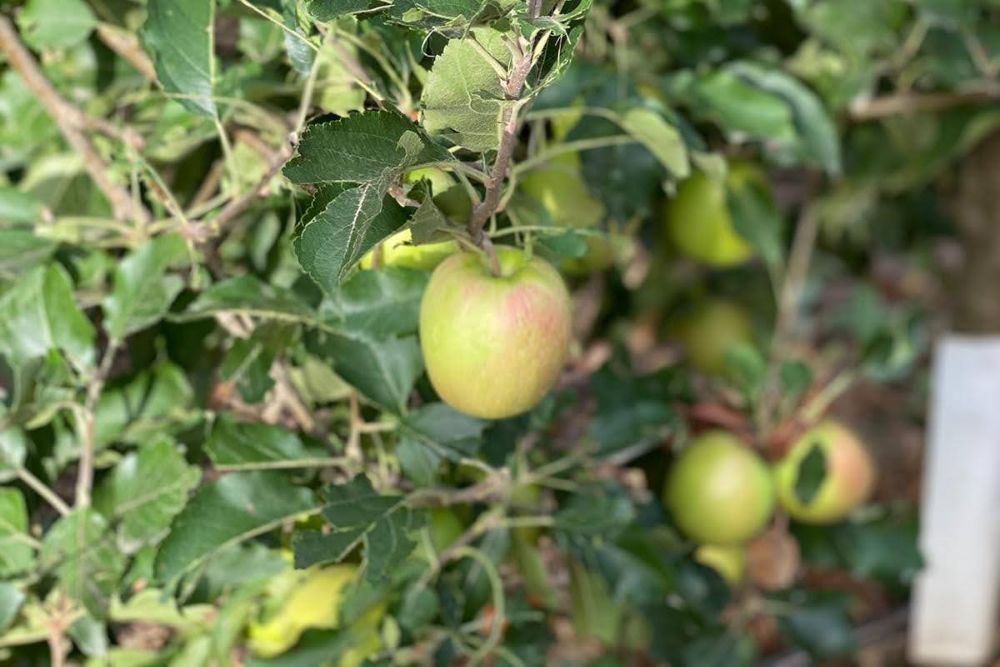
The Subjectivity of Sunlight, Sight and Manual Sampling
Manual sampling carries human subjectivity.
In a commercial orchard, different areas mature at different rates, reaching the commercial target for fruit colour and blush at different moments in time. The optimal harvest window can be guided by assessing fruit colour on the trees throughout the orchard, but conventional measurement approaches are subjective and error-prone for a number of reasons:
- Sun-Angle Bias: Fruit Colour perceived by an observer is a complex combination of the colour of the outer fruit layer, and the ambient illumination. Fruit colour looks different at 8:00 AM than it does at 2:00 PM on the same day. Shadows and cloud cover make it even more difficult for scouts to get a consistent sense of blush or maturity across a large orchard block.
- Scouting Bottleneck: Manual colour assessment is generally far too slow and costly to cover 100% of an orchard. The bulk of the orchard will not be assessed at all, resulting in management decisions based on gut-feel rather than hard data.
- The Cost of Poor Timing: If a harvest is called too early, the fruit may lack the blush required for ‘Premium’ grade. If called too late, the shelf life can be compromised. Without accurate data, growers often miss the peak value window.
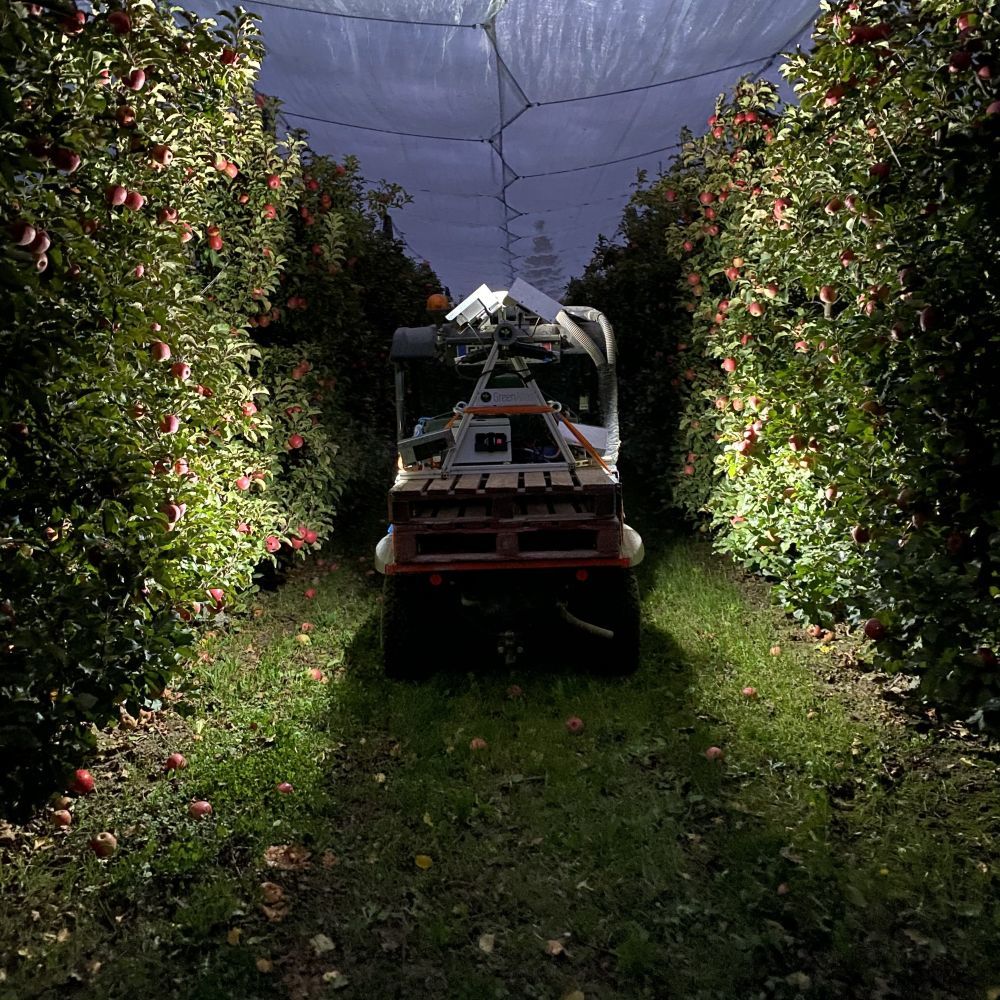
Standardised Imaging via Controlled Illumination
Replace manual sampling with an objective audit of the total orchard.
Green Atlas Cartographer minimises external environmental variables by bringing its own powerful lighting system to the orchard, providing an objective fruit colour assessment while driving rapidly past each tree.
- Powerful Artificial Illumination: The system uses a patented industry leading high-intensity strobe lighting system that overpowers ambient sunlight. This ensures that every photo is taken under standardised lighting conditions, whether it is high noon or an overcast morning.
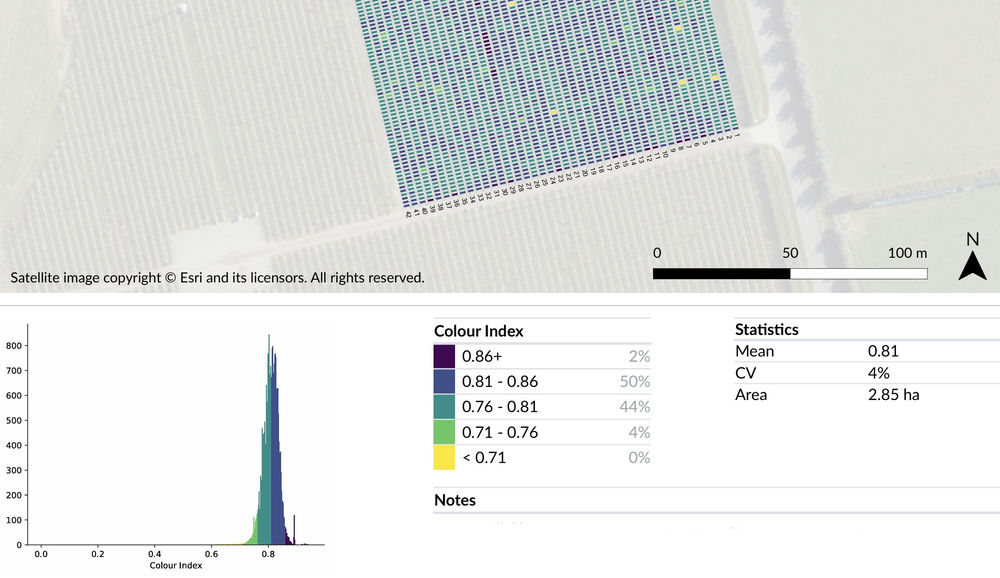
- Colour Categorisation: Maps can be viewed in a true-colour mode, where the map is coloured by the fruit colour at each location, however this can hide subtle colour variations that are invisible to the human eye. A scientifically developed and validated Colour Index is used to highlight these subtle variations.
- Total Canopy Audit: Because the cameras capture the tree from top to bottom, the system provides a colour profile of the entire fruiting zone, not just the easily accessible fruit, over the entire orchard.
Precision Harvest and Quality Control
No longer guess your fruit maturity or blush.
By turning fruit colour into a geo-referenced data layer, growers can move from guessing maturity to scheduling it:
- Dynamic Harvest Timing: Managers receive heatmaps showing which blocks (or portions of blocks) have reached the colour threshold for picking. This enables ‘spot picking’ or ‘selective harvesting’, ensuring the highest value packout.
- Input Planning for Colour Development: By mapping colour early, agronomists can identify zones where colour is lagging. This allows for targeted interventions, such as variable-rate application of colour-promoting sprays/nutrients, precise reflective mulch placement or targeted use of leaf defoliating machines.
- Maturity-Based Logistics: The packing shed can be notified of the incoming colour profile, allowing them to pre-sort fruit in the system and allocate it to the correct market (e.g., high-blush export vs. standard-blush domestic).
- Objective Benchmarking: Growers can track colour development week-over-week, building a historical ‘maturity curve’ that makes future seasons more predictable.
Get Started
Measure the colour of your fruit. Everywhere.
Find your nearest Green Atlas service provider to discuss how fruit colour assessment can improve your forward-planning.